

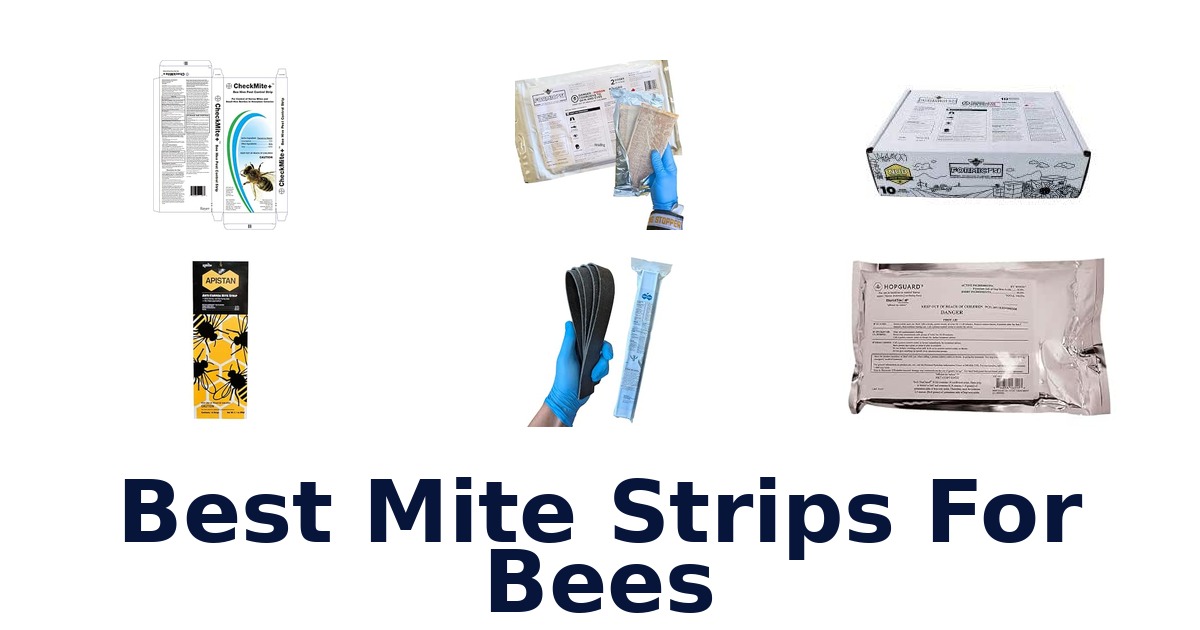
A strong mite strip choice matches the treatment format and colony situation you can manage, and Varroxsan suits beekeepers seeking a ready-to-use, sustained-release option. This roundup compares ten products, including oxalic acid, formic acid, amitraz, hop-compound and Apistan strips. The listed treatment details vary considerably: Varroxsan provides 42–56 days of release, Formic Pro packs supply two or ten doses, and HopGuard 3 includes 24 strips for 12 treatments.
Some options also list a use for small hive beetles, while others specify a strip-per-frames ratio. Product labels and directions matter: check the current instructions for the exact product and colony conditions rather than treating these options as interchangeable.
The rankings prioritize stated fit, useful treatment details and included quantities.
Varroxsan Oxalic Acid Strips leads because its listing specifies ready-to-use oxalic acid strips with controlled release for 42–56 days and no mixing or reapplication. It is the clearest fit for beekeepers seeking an extended-duration strip treatment. Formic Pro is a notable alternative when the listed formic-acid treatment and its ability to reach mites under capped brood are relevant; Apivar 2.0 offers an amitraz option with a stated colony-size-based strip ratio.
Follow each product’s label, since application and treatment requirements differ.
Our Top Picks

Ready-to-use oxalic acid strips provide controlled release for 42–56 days, with listed pack sizes covering 5–300 colonies.
View on Amazon Capped-Brood Reach
Formic acid vapor is described as penetrating capped brood cells, and the pack includes enough strips for two treatment applications.
View on Amazon Most Treatments
The 24-strip pack is listed as 12 treatments, and the product description names compatibility with several hive types and colony setups.
View on Amazon- Large Colony Pack Mann Lake Apivar 2.0
- Dual Pest Use Mann Lake CheckMite+
Compare the mite-treatment strip options
| # | Product | Weight | Buy |
|---|---|---|---|
| 1 | 1. VITA BEEHEALTH VarroxsanBest Overall | 0.76 kg | View on Amazon |
| 2 | 2. Foxhound Formic ProCapped-Brood Reach | 1.5 lb | View on Amazon |
| 3 | 3. Mann Lake HopGuard 3Most Treatments | 1.75 lb | View on Amazon |
| 4 |  4. Mann Lake Apivar 2.0Large Colony Pack | — | View on Amazon |
| 5 |  5. Mann Lake Formic ProQuick-placement formic treatment | 1.54 lb | View on Amazon |
| 6 |  6. Mann Lake CheckMite+Dual Pest Use | — | View on Amazon |
| 7 |  7. Formic Pro 10-DoseFlexible storage and treatment planning | — | View on Amazon |
| 8 |  8. Foxhound Apivar 2.0Amitraz strip treatment users | 3.2 oz | View on Amazon |
| 9 |  9. Mann Lake ApistanSpring and fall Apistan planning | 0.01 oz | View on Amazon |
| 10 |  10. Apistan Varroa StripsSeasonal spring and fall hive care | — | View on Amazon |
Detailed Reviews: Best Mite Strips For Bees
#1 · Best Overall
1. VITA BEEHEALTH Varroxsan
- Weight: 0.76 kg
Best for: Extended treatment for small apiaries.
Why it ranks #1: Ready-to-use oxalic acid strips provide controlled release for 42–56 days, with listed pack sizes covering 5–300 colonies.
A controlled oxalic-acid release lasting 42–56 days is the defining feature of VarroxSan, giving beekeepers a longer treatment window without mixing a solution. The 20-strip pack is listed for five to ten colonies, making its stated capacity easy to match to a smaller apiary.
These ready-to-use strips hang between frames, so treatment does not require preparing a liquid or reapplying during the stated 42–56-day period. The oxalic acid dihydrate, glycerin, and cardboard matrix provide the listed sustained-release format, while the product information says it is safe for bees, brood, and queens. Packs can be opened and sealed for later use, which helps when treating colonies in stages. The label should be followed, and sale or use is not approved in California.
- Controlled oxalic-acid release for 42–56 days
- Ready to use without mixing
- Hangs between frames
- Pack stated to treat five to ten colonies
- Not approved for sale or use in California.
Skip it if you need a treatment approved for use in California; VarroxSan is not approved for sale or use there.
For a beekeeper treating five to ten colonies who wants a ready-to-hang oxalic-acid strip with a 42–56-day release, this pack fits the stated scale. It is not suitable for California use.
Full product details
| Brand | VITA BEEHEALTH |
|---|---|
| Included Components | Varroxsan Strips |
| Item Form | Strip |
| Item Weight | 0.76 kg |
| Manufacturer | VITA BEEHEALTH |
| Model Number | 20 Strips |
Listed on Amazon as: Varroxsan Oxalic Acid Strips Varroa Mite Treatment for Beehives, 20 Strips | Slow-Release Strip, Easy Mite Management
View on Amazon#2 · Capped-Brood Reach
2. Foxhound Formic Pro
- Weight: 1.5 lb
Best for: Formic-acid brood-cell treatment.
Why it ranks #2: Formic acid vapor is described as penetrating capped brood cells, and the pack includes enough strips for two treatment applications.
Formic acid vapor can penetrate capped brood cells, where Varroa mites reproduce, distinguishing Formic Pro from contact-only treatment approaches. This pack contains enough strips for two complete treatment applications under the labeled options, giving beekeepers a defined two-application supply for managing colony mite populations.
The vapor’s ability to enter capped brood cells is relevant when mites are reproducing beneath cell caps, while the strip format keeps application within the hive-treatment workflow. Foxhound Bee Company’s listing specifies two complete applications and directs users to follow the labeled treatment options. That makes the pack’s supply easier to plan across treatment cycles, but does not replace checking the label for the applicable option and directions. The supplied facts identify formic acid as the active treatment basis, not a dosing schedule.
- Formic acid-based treatment
- Vapor penetrates capped brood cells
- Pack provides two complete applications
- Strip format for hive treatment
- The supplied listing does not specify a treatment duration.
Skip it if you need an explicitly stated treatment duration; Mann Lake CheckMite+ lists removal after 42–45 days.
This is a fit for beekeepers seeking formic-acid vapor that reaches capped brood cells and a pack for two labeled applications. Consult the treatment options and label directions, since duration is not stated in the supplied details.
Full product details
| Brand | Foxhound Bee Company |
|---|---|
| Included Components | 2 doses |
| Item Form | Strip |
| Item Weight | 1.5 pounds |
| Manufacturer | NOD Apairy Products |
Listed on Amazon as: Foxhound Bee Co Formic Pro Varroa Mite Treatment Strips
View on Amazon#3 · Most Treatments
3. Mann Lake HopGuard 3
- Weight: 1.75 lb
Best for: Multi-hive and varied hive formats.
Why it ranks #3: The 24-strip pack is listed as 12 treatments, and the product description names compatibility with several hive types and colony setups.
HopGuard 3 is listed as compatible with Langstroth, top bar, mating nuc, drone mother, nucleus, split, and newly installed package setups. That breadth makes the 24-strip supply relevant to beekeepers managing varied colony formats, while its hop-compound approach is identified as the mite-control basis.
The product information says hop compounds are used to control Varroa mites and that honey and wax integrity is not compromised. Its listed compatibility across established hives and smaller or newly installed colonies can simplify product selection for operations with mixed setups. The 24 strips are described as 12 treatments, giving buyers a stated treatment count for planning. The supplied facts do not spell out a per-colony strip ratio, so the included directions remain important when allocating strips.
- Uses hop compounds for mite control
- Listed for multiple hive and colony formats
- 24 strips provide 12 treatments
- Listing says honey and wax integrity is not compromised
- The supplied details do not state a per-colony strip ratio.
Skip it if you need a stated one-strip-per-five-frames dosage; Mann Lake Apivar 2.0 provides that direction in its product details.
This pack fits beekeepers managing varied hive types who want the listed hop-compound treatment and 12 stated treatments. Check the product directions for allocation, since the supplied information does not give a per-colony strip ratio.
Full product details
| Brand | Mann Lake |
|---|---|
| Item Weight | 1.75 pounds |
| Item model number | DC311 |
| Manufacturer | Mann Lake |
| Dimensions | 7.5 x 13 x 1.5 inches |
Listed on Amazon as: Mann Lake HopGuard 3, 24 Strips (12 Treatments)
View on Amazon#4 · Large Colony Pack
4. Mann Lake Apivar 2.0
Best for: Large-scale Apivar treatment supply.
Why it ranks #4: The 60-strip pack offers a larger supply, while the listing describes spring and fall use during periods of strong bee activity.
With 60 strips, Mann Lake Apivar 2.0 offers a substantially sized supply for beekeepers organizing treatment across many colonies. Its listing identifies a newer Véto-pharma formulation and positions it for spring and fall treatment during strong bee activity, giving seasonal context for planning use.
The 60-strip quantity can support broader treatment planning than a small pack, although the supplied listing does not specify a per-colony dose. The product is presented as a next-generation Varroa solution developed by Véto-pharma’s Innovation team, with federal EPA registration in the USA stated in the listing. Spring and fall use during strong bee activity provides a seasonal frame for scheduling. Buyers should consult the label for dosage and application details before allocating strips among colonies.
- 60 strips included
- Identified as Apivar 2.0
- Listed for spring and fall treatment
- EPA federal registration in the USA is stated
- The supplied product details do not specify a per-colony dose.
Skip it if you need a stated one-strip-per-five-frames dosage; Foxhound Bee Company Apivar 2.0 lists that dosing direction.
This is suited to beekeepers planning Apivar 2.0 treatment across a larger operation and using spring or fall treatment windows. Confirm dosage and application directions from the label, since the supplied listing gives no per-colony ratio.
Full product details
| Brand | Mann Lake |
|---|---|
| Manufacturer | Mann Lake |
Listed on Amazon as: Mann Lake Apivar 2.0 Varroa Mite Treatment Strips, 60 Strips
View on Amazon#5
5. Mann Lake Formic Pro
- Weight: 1.54 lb
Best for: Quick-placement formic treatment.
Why it ranks #5: This two-dose formic acid treatment is described as an organic miticide that can kill mites under cell caps; placement takes minutes.
Placement takes only minutes according to the listing, making Mann Lake Formic Pro a practical option for beekeepers prioritizing a quick hive-treatment step. Its full-dose treatment is described as killing mites beneath cell caps, addressing the location where they reproduce rather than limiting the stated effect to exposed mites.
The product is an organic miticide, and the listing says a full dose kills mites under the cell cap where they reproduce. That target may matter to beekeepers planning treatment around brood, while the placement process is described as taking only minutes. After treatment, the material is said to be dry and safe to handle and compostable. The supplied information refers to two treatment options but does not give their detailed instructions here, so use the product directions to select and apply a dose.
- Placement in the hive takes minutes
- Full dose targets mites under cell caps
- Material is compostable when dry
- Two treatment options are referenced
- The supplied details do not provide the two options’ instructions.
Skip it if you want the complete treatment options in the supplied product details; VarroxSan lists ready-to-use placement between frames.
This option suits a beekeeper who values quick placement and a full dose described as targeting mites beneath cell caps. The listed material can be composted once dry; follow product directions for the two treatment options.
Full product details
| Brand | NOD Apiary Products |
|---|---|
| Item Weight | 1.54 pounds |
| Manufacturer | NOD |
| Package Dimensions | 13.66 x 8.74 x 0.87 inches |
Listed on Amazon as: Mann Lake Formic Pro Varroa Mite Treatment, 2-Dose
View on Amazon#6 · Dual Pest Use
6. Mann Lake CheckMite+
Best for: Varroa and small hive beetle care.
Why it ranks #6: The 10-pack is listed for Varroa mites and small hive beetles, with removal after 42–45 days and one strip per five frames of bees.
CheckMite+ is listed for both Varroa mites and small hive beetles, giving it two stated pest-control uses in one strip product. For Varroa treatment, the instructions specify one strip per five frames of bees when brood rearing is lowest, with removal after 42–45 days.
The frame-based Varroa direction helps plan strip placement around colony size, while the lowest-brood-rearing timing gives a specific point to consider before application. The strips are also listed for small hive beetle treatment, with separate attachment instructions in the product information. Removal after 42–45 days creates a defined follow-up task, and the listing advises testing for mites before treatment. These directions make monitoring and scheduled removal part of the use workflow, rather than a place-and-forget approach.
- Listed for Varroa mites and small hive beetles
- One strip per five frames for Varroa
- Removal after 42–45 days is specified
- Instructions advise testing for mites first
- Treatment requires a planned removal after 42–45 days.
Skip it if you want a treatment with a stated 42–56-day release window; VITA BEEHEALTH VarroxSan lists that duration.
Beekeepers addressing Varroa and small hive beetles may appreciate the dual-use listing and frame-based Varroa directions. Plan to test before application, treat when brood rearing is lowest, and return to remove strips after 42–45 days.
Full product details
| Brand | Mann Lake |
|---|---|
| Color | White |
| Dimensions | 4"L x 1"W x 6"H |
| Manufacturer | Mann Lake |
| Part Number | DC810 |
| Model Number | DC810 |
Listed on Amazon as: CheckMite+ Bee Hive Pest Control Strips | 10-Pack
View on Amazon#7
7. Formic Pro 10-Dose
Best for: Flexible storage and treatment planning.
Why it ranks #7: The listing includes 10 doses and highlights extended shelf life, making this a larger-supply formic acid option.
An extended shelf life that avoids special temperature storage is the practical differentiator of this 10-dose Formic Pro pack, letting beekeepers keep treatment on hand for flexible use. The listing also specifies zero honey residue and an eco-friendly formula, two product claims relevant to treatment planning.
Because the product is described as not needing special temperature storage, it may be easier to keep available between treatment periods than a product with a stated temperature requirement. Its 10-dose quantity supports planning across multiple applications, while the listed zero-honey-residue claim may matter to beekeepers considering honey handling. The supplied facts identify this as a formic-based Varroa treatment and describe its materials as natural and eco-friendly. Follow the product directions for application and timing; those specifics are not included here.
- Extended shelf life is listed
- No special temperature storage required
- 10 doses included
- Zero honey residue is claimed
- The supplied details do not specify application timing.
Skip it if you need a stated application schedule in the supplied details; Mann Lake CheckMite+ lists timing and removal guidance.
This 10-dose pack suits beekeepers who value flexible storage and the listed zero-residue claim. The supplied information does not provide application timing, so consult the product directions before planning a treatment window.
Full product details
| Brand | Formic Pro |
|---|---|
| Included Components | 10 doses |
| Item Form | Strip |
| Manufacturer | Nod Apairy Products |
Listed on Amazon as: Mann Lake Formic Pro Varroa Mite Treatment, Bee Colony Mite Control, Combat Varroosis, Extended Shelf Life, Residue-Free, Eco-Friendly Formula,10-Dose
View on Amazon#8
8. Foxhound Apivar 2.0
- Weight: 3.2 oz
Best for: Amitraz strip treatment users.
Why it ranks #8: These amitraz polymer strips install between brood frames; the listed ratio is one strip per five frames of bees in each brood chamber.
Apivar 2.0 uses controlled-release polymer strips containing amitraz, a concrete choice for beekeepers seeking an amitraz-based Varroa treatment placed inside the brood chamber. Its placement between brood frames avoids mixing or measuring, while the stated dosage is tied to frames of bees rather than hive count.
The instructions call for one strip per five frames of bees in each brood chamber, so buyers need to assess colony strength rather than simply count hives. Strips go directly between brood frames and require no mixing or measuring, simplifying preparation at the hive. The supplied product information says this newer formulation is intended to produce a mite drop within the first three weeks. With four strips in the listed pack, its quantity must be considered against the colony’s frame count and chambers.
- Amitraz delivered through controlled-release polymer strips
- Placed between brood frames
- No mixing or measuring required
- Dosage is based on frames of bees
- Four strips may cover only a limited number of frames, depending on colony size.
Skip it if you need strips for many colonies; Mann Lake Apivar 2.0 is listed as a 60-strip pack for larger-scale treatment needs.
This pack suits beekeepers choosing an amitraz strip and willing to calculate dosage by frames of bees in each brood chamber. Its four-strip quantity makes colony strength and the one-per-five-frames direction central to planning.
Full product details
| Brand | Foxhound Bee Company |
|---|---|
| Item Weight | 3.2 ounces |
| Manufacturer | Veto-Pharma |
| Package Dimensions | 15.55 x 5.59 x 0.39 inches |
| Additional Information | Important information Ingredients Amitraz – 3.33%, 96.67% (plastic polymer strip) |
Listed on Amazon as: Apivar® 2.0 Amitraz Strips for Varroa Mite Control – 4 Strips
View on Amazon#9
9. Mann Lake Apistan
- Weight: 0.01 oz
Best for: Spring and fall Apistan planning.
Why it ranks #9: This 10-strip pack specifies one strip per five frames of bees and describes spring-before-flow or fall-after-flow treatment timing.
The listing gives a specific seasonal window for Apistan: treat in spring before the first honey flow or in fall after the last honey flow. Its one-strip-per-five-frames recommendation makes the 10-strip pack easier to allocate by bee coverage rather than by hive count alone.
Frame-based dosing supports planning across colonies of different sizes, while the spring and fall timing anchors treatment to honey-flow periods. The pack contains 10 strips, so its stated coverage can be estimated from the recommended one strip for every five frames of bees. The listing describes Apistan as used for detecting and controlling Varroa mites, but does not provide a treatment duration. Follow the product directions when scheduling and placing strips around the relevant flow periods.
- Recommended for spring before first honey flow
- Recommended for fall after last honey flow
- One strip per five frames of bees
- 10 strips included
- The supplied details do not specify treatment duration.
Skip it if you need a stated 42–45-day removal interval; Mann Lake CheckMite+ lists that timing for its strips.
This pack suits beekeepers planning Apistan use around spring and fall honey-flow boundaries, with strip counts based on frames of bees. Its supplied details omit treatment duration, so use the product directions to plan the full course.
Full product details
| Brand | Mann Lake |
|---|---|
| Item Weight | 0.01 ounces |
| Item model number | DC665 |
| Manufacturer | Mann Lake |
| Dimensions | 13.5 x 4.63 x 4.63 inches |
Listed on Amazon as: Mann Lake DC665 10-Pack Apistan Strips
View on Amazon#10
10. Apistan Varroa Strips
Best for: Seasonal spring and fall hive care.
Why it ranks #10: The 10-pack offers simple hanging application and states that each strip covers five frames, but provides fewer treatment details than higher-ranked options.
Each strip covers up to five frames of bees, giving this 10-pack a clear frame-based application guide for seasonal hive care. The listing specifically positions use in spring and fall, so it can fit a beekeeper’s recurring maintenance schedule without adding a cleanup step after hanging.
The stated coverage of up to five frames per strip helps translate the 10-strip pack into a colony-by-colony plan. Its simple hanging application and no-cleanup claim support efficient work during spring or fall hive visits. The product is presented for hobbyists and experienced beekeepers alike, but the supplied details do not specify an active ingredient or treatment duration. Buyers should therefore use the product’s directions and seasonal context rather than assume particulars not included in the listing.
- Each strip covers up to five frames of bees
- 10-strip pack
- Positioned for spring and fall use
- Hanging application requires no cleanup
- The supplied product details do not state an active ingredient.
Skip it if you require a named treatment ingredient; Mann Lake Formic Pro specifies formic acid in its supplied product details.
A beekeeper planning spring and fall hive care may value the frame-based coverage and no-cleanup hanging format. Choose it with the understanding that its supplied listing does not identify an active ingredient or treatment duration.
Full product details
| Brand | Apistan |
|---|---|
| Manufacturer | Apistan |
| Part Number | Apistan |
Listed on Amazon as: Varroa Mite Strips – 10 Pack Beekeeping Supplies for Bee Hives – Mite Management for Bee Colonies – Easy Application for Spring and Fall – Beekeeping Accessories
View on AmazonWhy treatment type is not interchangeable
No single strip type in this roundup should be treated as interchangeable with the others: the listed active ingredients and delivery approaches differ. Varroxsan uses oxalic acid in a cardboard matrix for a stated 42–56-day release, while Apivar 2.0 uses amitraz in a controlled-release polymer strip. Formic Pro is based on formic acid, with the listing describing vapor that reaches capped brood cells.
HopGuard 3 uses hop compounds, and the Apistan listings do not identify an active ingredient in the supplied product details. These differences matter when comparing directions, seasonal suitability and treatment planning; a longer stated release period does not establish that a product fits every colony or situation.
Check the label for the exact item you have, follow its application directions and do not infer that products can be combined or rotated in a particular way from this roundup alone.
Count the treatment dose, not just the strips
Strip count alone can mislead because packs describe quantities in different ways. HopGuard 3 lists 24 strips as 12 treatments, while Formic Pro packages are described as two doses or, in another listing, 10 doses. Varroxsan’s 20-strip pack is stated to treat 5–10 colonies, and its larger 60- and 600-strip packs are listed for 15–30 and 150–300 hives.
Apivar 2.0, by contrast, gives a colony-size ratio: one strip per five frames of bees in each brood chamber. That means a strong colony may require more strips than a smaller one, so comparing package totals without checking the directions can leave you short.
Confirm what the label means by a dose, how many strips a colony needs, and whether the product’s listed pack quantity suits your number and size of colonies.
How to Choose Bee Mite Strips
Active ingredient and delivery
Start by checking the active ingredient and how the product delivers it. This selection includes oxalic acid strips in a cardboard matrix from VITA BEEHEALTH Varroxsan, amitraz polymer strips in both Apivar 2.0 listings, formic acid treatments from Formic Pro, and hop-compound strips from HopGuard The Formic Pro description specifically says vapor can penetrate capped brood cells; Varroxsan instead specifies sustained release for 42–56 days.
Choose based on the treatment approach and instructions appropriate to your situation, not a general assumption that one ingredient works in every circumstance. If you need a clearly stated extended-release format, Varroxsan has the most explicit duration in this set; if capped-brood reach is your deciding feature, consider the Formic Pro descriptions and verify the label.
Treatment length and timing
Look for a stated duration or treatment timing that fits your plan. Varroxsan lists 42–56 days of controlled release, and CheckMite+ says to remove strips after 42–45 days. Apistan’s Mann Lake listing describes treatment in spring before the first honey flow or fall after the last, while the Apistan-branded 10-pack mentions spring and fall use without giving a duration.
Formic Pro listings describe dose counts rather than a duration in the supplied details. The products therefore do not provide equally complete timing information.
If a stated release window is important, Varroxsan is the clearest match; if you are comparing seasonal timing, review the relevant product label and do not infer that another product follows the same schedule.
Dose quantity and colony size
Match the pack to the number and size of colonies, using the product’s stated dose guidance rather than strip totals alone. Varroxsan lists 20 strips for 5–10 colonies, 60 for 15–30 and 600 for 150–HopGuard 3 lists 24 strips as 12 treatments; Formic Pro packs list two doses or 10 doses.
Apivar 2.0 specifies one strip per five frames of bees in each brood chamber, so colony strength affects the number needed. Smaller operations may prefer a clearly described smaller pack, while beekeepers treating many colonies may value Varroxsan’s larger quantity or Formic Pro’s 10-dose listing.
Check the exact label before ordering because a pack’s strip count does not necessarily equal its treatment count.
Which Mite Strips Should You Choose?
For a ready-to-use strip with a stated 42–56-day release period, choose VITA BEEHEALTH Varroxsan, the top-ranked option. If reaching mites under capped brood is your priority, Foxhound Formic Pro is the clearest match in the supplied details and includes two applications. Larger operations can compare Mann Lake Apivar 2.0’s 60-strip pack, Varroxsan’s 60- or 600-strip options, and Formic Pro 10-Dose, checking each label’s dose requirements.
Choose Mann Lake CheckMite+ if the listed small hive beetle use matters alongside Varroa treatment. HopGuard 3 offers 24 strips described as 12 treatments.
For any option, confirm the active ingredient, colony-size directions and timing on the current label before treating; pack count alone does not determine the dose.
Frequently Asked Questions
How should I check whether a mite treatment is appropriate for my colony right now?
Check the product’s current label against your colony’s condition, treatment timing, application directions, and any stated colony-size requirements. Also confirm that the listed active ingredient and treatment method fit your situation. If the label does not clearly address your circumstances, consult a qualified local beekeeping adviser before treating.
Can I use different mite-treatment active ingredients in the same season?
Different active ingredients may be options within a season, but do not assume they can be combined or used consecutively without restrictions. Read each product’s current label for application timing, compatibility, and any limits on use, and consult a qualified adviser if unclear. The products listed include oxalic acid, formic acid, and amitraz options.
How do I monitor mite levels before and after treating a hive?
Use a consistent mite-monitoring method before treatment and repeat it afterward at an appropriate interval. Follow the treatment label for timing and any monitoring guidance, and keep records so you can compare results. If mite levels remain concerning or the results are unclear, seek advice from a qualified local beekeeping resource.
How should colony size affect the strip dose?
Use the colony-size directions on the current product label; do not choose a dose from pack count alone. The listed Apivar 2.0 option specifies a colony-size-based strip ratio, while requirements differ among products. Confirm the correct application amount and timing for your colony before treating.
Does a larger pack mean more treatments for my hive?
Not necessarily: pack count alone does not determine how many treatments a pack provides, because dose requirements differ by product and colony. HopGuard 3 is described as 24 strips for 12 treatments, while other listings give strip counts or dose counts. Check the current label to understand the intended use.
Final Words
For a ready-to-use strip with a stated 42–56-day controlled-release period, Varroxsan is the clearest fit and the top-ranked option. Choose Formic Pro when reaching mites under capped brood is the priority, or compare Apivar 2.0 for its amitraz option and stated colony-size-based strip ratio. CheckMite+ is relevant when its listed small hive beetle use matters.
Before buying or treating, confirm the current label’s active ingredient, dose, and timing; pack count alone does not establish dose.