

There is something inherently grounding about a bubbling pot of beans simmering on the stove, filling the kitchen with the earthy warmth of toasted cumin, sweet allium aromatics, and rich woodsmoke. Bean soups have sustained communities across the globe for centuries—from rustic Mexican sopa de frijoles to comforting Mediterranean stews—precisely because they transform humble, shelf-stable staples into something deeply nourishing and soul-satisfying.
This specific recipe was born out of a chilly Tuesday evening when time was short, energy was lower, and the refrigerator held little more than a couple of root vegetables and a can of fire-roasted tomatoes. I wanted the deep, slow-cooked character of grandmother-style heirloom beans simmered all afternoon with aromatics, but I had roughly forty-five minutes before dinner needed to be on the table. By taking canned pinto beans, pairing them with sweet diced carrots, tender starchy potatoes, and a trio of assertive pantry spices—smoked paprika, cumin, and oregano—we strike a balance between lightning-fast convenience and slow-simmered complexity.
What truly sets this version apart is its textural engineering. Rather than settling for a watery broth with whole beans sinking to the bottom, or turning the entire batch into baby-food puree, we split the difference. Puréeing half the soup creates an ultra-velvety, naturally gluten-free base that coats the back of your spoon, while leaving the remaining half intact preserves bite, chew, and rustic charm. It is unfussy home cooking at its absolute best: budget-conscious, naturally plant-based, and layered with smoky, sun-drenched flavor.
Kitchen Logistics, Timing, and Prep Strategy
From cutting board to dinner table, this entire meal comes together in about 45 minutes, with only 15 minutes of hands-on chopping. The remaining half hour is hands-off simmering time, making it ideal for busy weeknights when you want to put your feet up or set the table while the stove does the heavy lifting. The recipe yields six generous, satisfying bowls. If you are cooking for a crowd or meal-prepping for the week ahead, the recipe doubles seamlessly without requiring additional cooking time—just ensure your stockpot has enough volume to accommodate the extra liquid without boiling over.
Beginner cooks can take heart: this is one of the most forgiving dishes you will ever make. Unlike baking, which requires razor-thin precision, soup-making is an intuitive, sensory craft. The essential equipment is straightforward: a heavy-bottomed Dutch oven or large soup pot (which distributes heat evenly and prevents the starchy potatoes from scorching), a sharp chef’s knife, and an immersion blender. If you don’t own an immersion blender, a standard countertop blender or even a manual potato masher will do the trick nicely.

For dedicated meal-preppers, this recipe is a dream. Like many chili and stew recipes, the flavors actually deepen and improve overnight as the starches settle and the garlic and dried herbs permeate the beans. You can chop your onions, carrots, and potatoes up to three days in advance and keep them chilled in an airtight container submerged in cold water (for the potatoes) or sealed in produce bags (for the carrots and onions). When dinner time arrives, your prep work is already complete.
The Ingredient Blueprint
Every element in this pot serves a distinct structural and flavor purpose.
| Ingredient | Role & Flavor Contribution | Smart Swaps & Notes |
|---|---|---|
| Olive Oil | Flavor carrier & bloom base | Avocado oil, butter, bacon fat |
| Yellow Onion | Sweet, aromatic backbone | White onion, shallots, or leeks |
| Garlic Cloves | Pungent, savory depth | 1/2 tsp garlic powder in a pinch |
| Carrots & Potato | Earthy sweetness & natural starch thickener | Sweet potato, parsnips, butternut; Yukon Golds hold shape best |
| Fire-Roasted Tomatoes | Charred acid & umami depth | Regular diced tomatoes + pinch of smoked paprika / chipotle powder |
| Spices (Cumin, Paprika, Oregano, Bay Leaves) | Warmth, woodsmoke, and herbal earthiness | Ground coriander, chili powder, Mexican oregano for citrus notes |
| Canned Pinto Beans | Creamy, nutty protein source | Black beans, white cannellini, or home-cooked dried pinto beans |
| Vegetable Broth | Savory, seasoned liquid body | Chicken stock or bouillon paste |
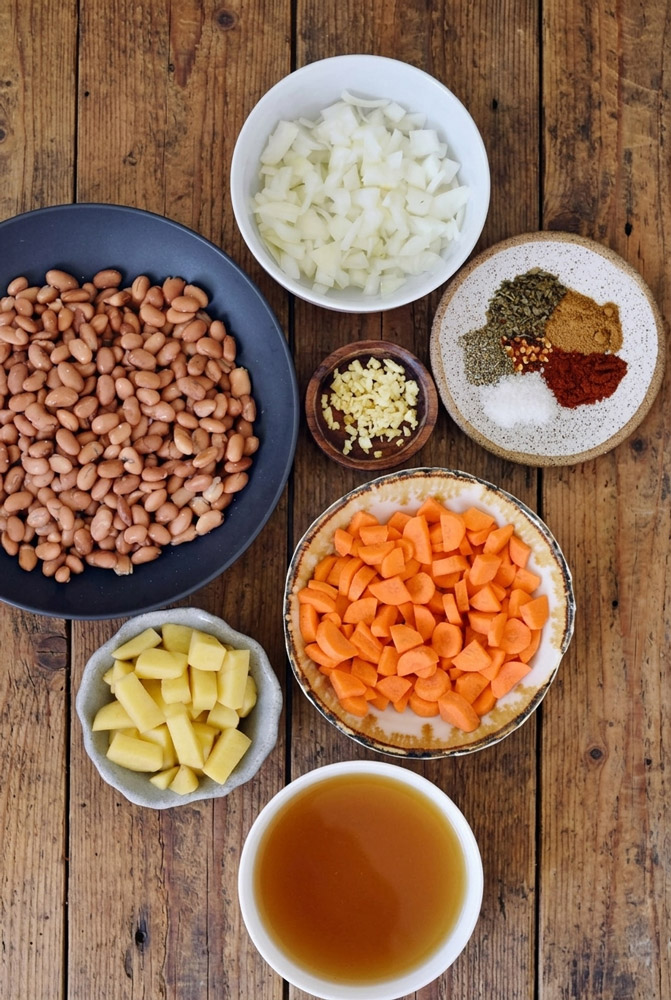
The foundation begins with a quality fat. A clean extra-virgin olive oil provides a fruity, peppery base, though neutral avocado oil or rendered fat work if you are not keeping the soup vegan. The yellow onion brings natural sugars that caramelize gently during the initial sauté, laying down a sweet aromatic foundation. Choose a firm, unblemished yellow or Spanish onion; red onions can turn an unappealing gray-purple when simmered with beans.
The garlic needs to be fresh. Pre-minced garlic from a jar lacks the sharp, clean punch of whole cloves chopped right before hitting the pan. For the root vegetables, a firm russet or Yukon Gold potato yields wonderful results. Russets break down slightly during simmering, lending their starch to thicken the broth naturally, while Yukon Golds provide a buttery, firm bite. The carrots add textural bite and balanced natural sweetness to counter the acidity of the tomatoes.
Speaking of tomatoes, fire-roasted canned diced tomatoes are non-negotiable if you want that wood-fired, slow-simmered taste in under an hour. Standard canned diced tomatoes will work, but fire-roasted varieties feature blackened flecks that impart instant smokiness. The spice trio—ground cumin, smoked paprika (pimentón), and dried oregano—anchors the flavor profile. The smoked paprika echoes the char of the tomatoes, while the cumin provides earthy, musky warmth. Dried Mexican oregano is ideal here if you can find it, as it offers a brighter, citrusy herbal note compared to sweeter Mediterranean oregano.
Finally, the pinto beans. Two 14-ounce cans provide creamy, nutty substance. Always drain and rinse canned beans in a fine-mesh colander before adding them to the pot. The canning liquid contains excess sodium and dissolved metallic starches that can muddy the clean flavors of your soup broth.
Step-by-Step Cooking Walkthrough
1. Sweat the Aromatics
Set your large soup pot or Dutch oven over medium-high heat and pour in the olive oil. Once the oil shimmers across the bottom of the pot, slide in your diced onions. Listen for a gentle, steady sizzle; if the onions crackle violently, lower the heat slightly to avoid browning them prematurely. Sauté the onions for 4 to 5 minutes, stirring frequently with a wooden spoon. You want them translucent, soft, and glossy, with just the faintest golden tint along the edges.
2. Bloom the Spices and Vegetables
Tumble in the minced garlic, diced carrots, peeled diced potatoes, and the can of fire-roasted tomatoes along with their juices. Immediately sprinkle the dried oregano, ground cumin, smoked paprika, and a pinch of red pepper flakes over the mixture. Stir continuously for 1 to 2 minutes. This step is known as “blooming”—letting the dried spices make contact with the hot oil and vegetables releases their fat-soluble essential oils. You will know it is working when your kitchen smells like a bustling spice market.
3. The Initial Simmer
Pour in two cups of quality vegetable broth and drop two dried bay leaves into the center of the pot. Bring the liquid up to an active, rolling boil. As soon as bubbles break across the entire surface, clamp a tight-fitting lid onto the pot and turn the heat down to low. Allow the vegetables to simmer undisturbed for 10 to 15 minutes. During this stage, the carrots and potatoes begin to tenderize and absorb the seasoned broth without turning mushy.

4. Incorporate the Beans
Remove the lid, releasing that concentrated cloud of tomato-herb steam, and tip in your drained, rinsed pinto beans. Stir thoroughly to disperse the beans evenly through the simmering broth. Leave the lid slightly ajar and let the soup continue to cook for another 10 minutes. Test for doneness by pressing a carrot and a potato cube against the interior side of the pot with your wooden spoon; they should yield smoothly under pressure without offering rubbery resistance. If too much broth has evaporated, splash in an extra half-cup of water or stock. Turn off the heat and discard the bay leaves.
5. The Split-Blend Technique
Here is where the texture turns luxurious. Ladle roughly half of the hot soup into a secondary heat-safe pot or bowl, or transfer it carefully to an upright blender (make sure to vent the blender lid with a clean folded kitchen towel to allow steam to escape). Blend this portion until completely silky and uniform. Pour the pureed soup back into the primary pot with the chunky vegetables and whole beans, stirring vigorously to marry the two textures. The soup instantly transforms into a rich, opaque, velvet-bodied stew without adding an ounce of cream, dairy, or flour.
6. Final Seasoning and Acid Adjustment
Taste your creation with a clean spoon. Broths vary widely in sodium content, so season assertively with kosher salt and freshly cracked black pepper. If the flavors taste slightly flat or heavy, stir in a teaspoon of fresh lime juice or apple cider vinegar. A tiny splash of acid cuts through the earthy beans and illuminates every spice.
Variations and Flavor Tweaks
- Spicy South-of-the-Border: Sauté a seeded, finely diced jalapeño or serrano pepper alongside the onions, or drop a tablespoon of minced canned chipotle peppers in adobo into the tomato mixture.
- Carnivore-Friendly: Render three strips of thick-cut bacon or a half-cup of diced Spanish chorizo in the pot first; remove the meat to drain, cook the vegetables directly in the rendered fat, and stir the crispy bits back in at the end.
- Seasonal Harvest: Swap the white potato for cubed butternut squash or sweet potato during autumn, and stir in two cups of chopped baby spinach or torn Tuscan kale during the final five minutes of simmering until wilted.
- Budget Pantry Shortcut: If you run out of vegetable broth, water simmered with a couple of garlic cloves, a bay leaf, and an extra pinch of salt produces a remarkably clean, delicious backdrop that lets the beans shine.

Serving and Storing
Ladle the piping-hot soup into wide, shallow ceramic bowls. To transform this humble bean soup into a restaurant-worthy centerpiece, contrast its rustic color with vivid, crunchy garnishes. Scatter plenty of fresh cilantro leaves across the top, add a fan of creamy sliced avocado, and finish with a sprinkle of crumbly cotija cheese or plant-based feta and a lime wedge. A side of warm, buttered cornbread, warm corn tortillas, or thick crusty sourdough makes the perfect dipping vessel. If serving with wine, a crisp, acidic Sauvignon Blanc or a chilled Spanish Garnacha beautifully balances the soup’s earthy cumin and smoked paprika notes.
Allow leftovers to cool to room temperature before transferring them to airtight glass containers. The soup will keep in the refrigerator for up to 5 days. As it chills, the potato starches will continue to absorb liquid, meaning the soup will be noticeably thicker the next day; simply loosen it with a splash of water or broth when reheating in a small saucepan over medium-low heat.
For longer preservation, this soup freezes wonderfully for up to 3 months. Portion it into freezer-safe containers, leaving a half-inch of headspace at the top to allow for liquid expansion as it freezes. Thaw overnight in the refrigerator and warm gently on the stovetop, stirring occasionally to restore its smooth consistency.