

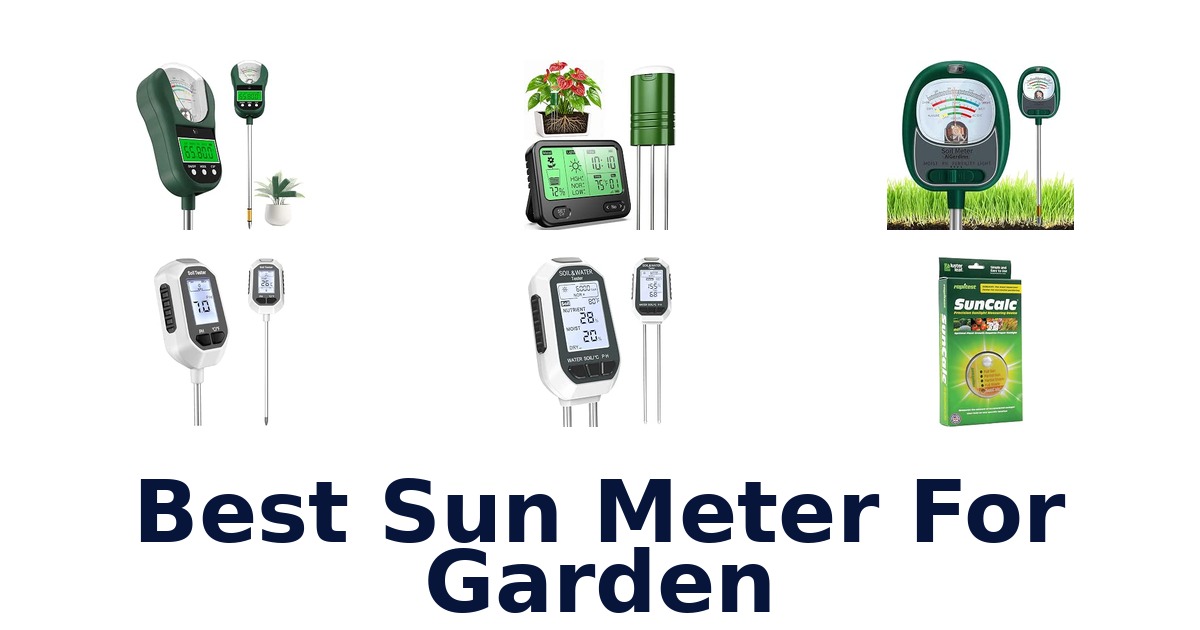
A strong garden sun meter records or classifies the light reaching a planting spot over time, making it useful for gardeners deciding where to place plants with specific sun needs. The EvoDevice EVO-20 DLI Light Meter leads this selection because it reports daily light integral and translates it into four exposure categories, with up to 10 days of history. Other options suit different jobs: the DANOPLUS meter measures PPFD and DLI and stores long-term records, while the Luster Leaf SunCalc measures accumulated PAR for a 12-hour period.
Several lower-ranked choices combine sunlight readings with soil tests, but are better suited to general plant care than precise light mapping. Choose based on whether you need a sun classification, light data, or a multi-purpose soil tool.
The EvoDevice EVO-20 DLI Light Meter is the best overall choice for most gardeners because it measures daily light integral, displays the result in mol/m2/day, and classifies a spot as full sun, partial sun, partial shade, or shade. It also stores up to 10 days of readings, so it can help compare locations beyond a single moment. Choose it for straightforward garden light placement; consider the DANOPLUS DLI Meter if PPFD measurement and longer data storage matter more.
Our Top Picks

It measures daily light integral, classifies four garden exposure categories, displays mol/m2/day, and stores up to 10 days of DLI readings.
View on Amazon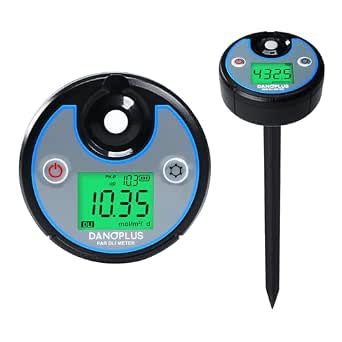 Highest Data Capacity
It measures PPFD from 0–5000 μmol/m2/sec and DLI, with up to five years of records and CSV export to a PC.
View on Amazon Accumulated PAR
It measures accumulated PAR over 12 hours and identifies full sun, partial sun, partial shade, and full shade for garden placement.
View on Amazon- Long-Term Monitoring EvoDevice EVO10 Soil Meter
Compare Garden Sun Meters at a Glance
| # | Product | Dimensions | Weight | Buy |
|---|---|---|---|---|
| 1 | 1. EvoDevice EVO-20 DLI MeterBest Overall | — | 5.3 oz | View on Amazon |
| 2 | 2. DANOPLUS DLI MeterHighest Data Capacity | 2.76 x 2.76 x 1.18 in | 3.52 oz | View on Amazon |
| 3 | 3. Luster Leaf SunCalcAccumulated PAR | 6 x 3 x 4 in | 3.2 oz | View on Amazon |
| 4 |  4. EvoDevice EVO10 Soil MeterLong-Term Monitoring | — | — | View on Amazon |
| 5 |  5. YAMRON 4-in-1 Soil TesterFor Multi-Measure Garden Checks | 2.36"W x 12.6"H | 120 g | View on Amazon |
| 6 |  6. AiGerdinn 4-in-1 Soil TesterFor Battery-Free Soil Checks | 1 x 1 x 1 in | 3.87 oz | View on Amazon |
| 7 |  7. SONKIR MS02 Soil TesterFor Simple Manual Soil Checks | 11.5 x 2 x 1.5 in | 2.89 oz | View on Amazon |
| 8 |  8. Buladeke 7-in-1 Soil TesterFor Broad Soil-and-Light Testing | — | 5.6 oz | View on Amazon |
| 9 |  9. Jxikatx 7-in-1 Soil TesterFor Digital Air and Soil Readings | 11 x 2.5 x 1.2 in | 5.6 oz | View on Amazon |
| 10 |  10. EDGEVEIL 4-in-1 Soil MeterFor Remote Garden Monitoring | 1.5 x 3.9 x 8.4 in | 9.1 oz | View on Amazon |
Detailed Reviews: Best Sun Meter For Garden
#1 · Best Overall
1. EvoDevice EVO-20 DLI Meter
- Weight: 5.3 oz
Best for: For DLI-Based Plant Placement.
Why it ranks #1: It measures daily light integral, classifies four garden exposure categories, displays mol/m2/day, and stores up to 10 days of DLI readings.
DLI-based sunlight classification is the EVO-20’s defining advantage: it identifies a location as Full Sun, Partial Sun, Partial Shade, or Shade from daily light integral readings. That gives gardeners a direct way to compare garden spots with plant light needs, without translating raw measurements through charts or calculations.
The display shows accumulated DLI in mol/m2/day alongside the light category, so a gardener can check both the measurement and its practical classification at the device. Up to 10 days of stored daily readings help compare changing light across days instead of relying on one observation. This makes it useful for deciding where to place plants or when to reassess a garden location; the category system is specifically tied to DLI rather than a simple momentary sunlight check.
- Classifies locations as Full Sun, Partial Sun, Partial Shade, or Shade
- Displays daily light accumulation in mol/m2/day
- Shows the light category directly without requiring calculations or charts
- Stores up to 10 days of daily DLI readings
- Stores only up to 10 days of DLI history.
Skip it if you need multi-year records or CSV export; DANOPLUS DLI Meter records up to five years and exports data to a PC.
Choose the EVO-20 if you want a clear DLI category to guide plant placement and a short history for checking daily variation. Its 10-day record is the boundary for gardeners who need longer-term tracking.
Full product details
| Brand | EvoDevice |
|---|---|
| Item Weight | 5.3 ounces |
| Item model number | EVO-20 |
| Manufacturer | De-Power |
| Package Dimensions | 7.32 x 3.19 x 1.73 inches |
Listed on Amazon as: EVO-20 DLI Light Meter – Smart Sunlight Classifier for Garden & Landscape Use | Identifies Full Sun, Partial Sun, Partial Shade & Shade Based on Daily Light Integral, 10 Days of DLI History
View on Amazon#2 · Highest Data Capacity
2. DANOPLUS DLI Meter
- Dimensions: 2.76 x 2.76 x 1.18 in
- Weight: 3.52 oz
Best for: For Long-Term DLI Data Tracking.
Why it ranks #2: It measures PPFD from 0–5000 μmol/m2/sec and DLI, with up to five years of records and CSV export to a PC.
Five years of DLI recording and PC export set the DANOPLUS apart for gardeners who want a durable light history rather than a single-day check. It measures both PPFD and DLI across the 400–700 nm range, connecting instantaneous photosynthetic light readings with accumulated daily exposure.
The meter measures PPFD from 0 to 5000 μmol/m2/sec and DLI, giving users both a light-flux reading and a daily integral for assessing plant light. It can store up to five years of DLI data and export records to a PC as CSV, which supports longer-term review beyond the device’s on-screen view of 30 days of DLI data and photoperiod. This range suits garden planning that benefits from saved records, rather than only a quick sunlight category.
- Measures PPFD and DLI
- PPFD range is 0–5000 μmol/m2/sec
- Records up to five years of DLI data
- Exports data to a PC in CSV format
- Long-term data export requires connecting the meter to a PC.
Skip it if you want a straightforward sunlight category without managing data exports; Luster Leaf SunCalc classifies exposure after a 12-hour measurement.
Choose the DANOPLUS for gardeners who need PPFD and DLI measurements with multi-year records and PC export. Its data workflow is a better fit for tracking light history than for a simple category-only spot check.
Full product details
| Brand | DANOPLUS |
|---|---|
| Item Weight | 3.52 ounces |
| Manufacturer | DANOPLUS |
| Dimensions | 2.76 x 2.76 x 1.18 inches |
#3 · Accumulated PAR
3. Luster Leaf SunCalc
- Dimensions: 6 x 3 x 4 in
- Weight: 3.2 oz
Best for: For Garden Spot Light Matching.
Why it ranks #3: It measures accumulated PAR over 12 hours and identifies full sun, partial sun, partial shade, and full shade for garden placement.
Accumulated PAR measurement is the Luster Leaf SunCalc’s key tool for matching a garden location to a plant’s light needs. It measures sunlight collected at a specific spot over 12 hours and classifies conditions as Full Sun, Partial Sun, Partial Shade, or Full Shade, turning a day’s exposure into useful placement guidance.
The SunCalc measures photosynthetically active radiation, the light plants use for photosynthesis, and accumulates it for 12 hours at a selected location. That makes it useful for comparing garden spots with plant nursery-tag requirements rather than judging exposure from a quick glance. The instructions call for placing it early in the day on a dry day when full sunlight is reasonably expected. Its process measures a specific location, so evaluation involves leaving the unit there through the measurement period.
- Measures photosynthetically active radiation (PAR)
- Accumulates light for 12 hours at a specific location
- Classifies Full Sun, Partial Sun, Partial Shade, and Full Shade
- Helps match garden locations to plant light requirements
- Requires a 12-hour measurement period at the location being evaluated.
Skip it if you cannot leave a meter in place for 12 hours; YAMRON CTY measures sunlight intensity as part of a multi-reading soil check.
Choose the SunCalc when you can leave a device in a garden spot for a 12-hour PAR reading to guide plant placement. Its measurement routine calls for a dry day and an early start.
Full product details
| Brand | Luster Leaf |
|---|---|
| Item Weight | 3.2 ounces |
| Item model number | 1875 |
| Manufacturer | Luster Leaf |
| Dimensions | 6 x 3 x 4 inches |
Listed on Amazon as: Luster Leaf 1875 Rapitest SunCalc Sunlight Calculator for Gardens – Measures Full Sun, Partial Sun, Partial Shade, and Full Shade. Designed and Engineered in the USA
View on Amazon#4 · Long-Term Monitoring
4. EvoDevice EVO10 Soil Meter
Best for: For Long-Term Root-Zone Monitoring.
Why it ranks #4: It provides sunlight-level categories alongside soil moisture and temperature, and is designed to remain in soil for long-term monitoring.
Two separated stainless-steel probes give the EvoDevice EVO10 a broader root-zone moisture reading than a single-point check, and the meter is intended to remain in soil long term. It also indicates soil temperature and sunlight level, including Full Sun, Partial Sun, Partial Shade, or Shade.
The dual probes sample across a wider area of soil, which the supplied description says helps reduce the influence of one wet pocket or dry patch on moisture readings. Because the EVO10 is designed to stay in soil, it supports ongoing monitoring rather than inserting and removing a spot-check meter for each reading. Sunlight levels are presented as four categories, adding a practical exposure cue alongside moisture and temperature for indoor or outdoor garden locations.
- Dual separated stainless-steel probes measure across a wider root-zone area
- Designed to remain in soil for long-term monitoring
- Indicates soil temperature and sunlight level
- Sunlight levels include Full Sun, Partial Sun, Partial Shade, and Shade
- Long-term soil monitoring requires leaving the sensor in the soil rather than using it only as a handheld spot-check tool.
Skip it if you want a handheld meter to insert and remove for each reading; SONKIR MS02 is described for soil spot checks.
Choose the EVO10 for gardeners monitoring moisture over time in a root zone, especially where one small wet or dry patch could distort a reading. Its leave-in approach suits ongoing placement, not quick handheld checks.
Full product details
| Brand | EvoDevice |
|---|---|
| Color | White |
| Included Components | Soil Sensor |
| Manufacturer | EVO10 |
| Model | Meter-EVO10 |
Listed on Amazon as: Leave in Soil Moisture Meter, Long Term in Soil Monitoring, Soil Temperature, Sunlight Level Indicator (Full Sun/Partial Sun/Partial Shade/Shade), Indoor Outdoor Garden
View on Amazon#5
5. YAMRON 4-in-1 Soil Tester
- Dimensions: 2.36"W x 12.6"H
- Weight: 120 g
Best for: For Multi-Measure Garden Checks.
Why it ranks #5: Its four functions include sunlight intensity as well as soil moisture, pH, and temperature, offering a combined plant-care tool rather than a dedicated sun meter.
Four measurements—soil moisture, pH, temperature, and sunlight—make the YAMRON CTY useful when plant care involves more than assessing brightness. Its backlit LCD brings these readings together on one tester, helping gardeners check soil conditions and sunlight during the same routine rather than carrying separate basic meters.
The 4-in-1 setup covers moisture, pH, temperature, and sunlight intensity, which can help connect a light check with the condition of the soil around a plant. A large LCD with white backlight is specified for viewing the readings, while the 12.6-inch height gives it a long tester form for garden use. It suits buyers seeking a combined soil-and-light check, rather than a device focused on DLI history or a sunlight category.
- Measures soil moisture, pH, temperature, and sunlight intensity
- Combines soil and sunlight checks in one tester
- Large LCD display
- White backlight for the LCD
- Reports sunlight intensity but does not list DLI history or sunlight-category classification.
Skip it if you need daily light categories and a recorded DLI history; EvoDevice EVO-20 provides both classification and 10-day storage.
The YAMRON CTY suits gardeners who want to check sunlight alongside soil moisture, pH, and temperature with one tester. Choose a DLI-specific meter instead if your planting decisions require daily light accumulation or categorized exposure.
Full product details
| Brand | YAMRON |
|---|---|
| Color | white |
| Item Dimensions W x H | 2.36"W x 12.6"H |
| Item Weight | 120 g |
| Manufacturer | cytentech |
| Model | CTY |
| Dimensions | 2.36"W x 12.6"H |
| Voltage | 6 volts |
Listed on Amazon as: 4-in-1 Soil Moisture Meter Digital Plant Temperature/Soil Moisture/PH Meter/Sunlight Intensity Backlight LCD Display Soil Test Meter for Gardening, Farming and Outdoor Plants
View on Amazon#6
6. AiGerdinn 4-in-1 Soil Tester
- Dimensions: 1 x 1 x 1 in
- Weight: 3.87 oz
Best for: For Battery-Free Soil Checks.
Why it ranks #6: It combines sunlight measurement with soil moisture, pH, and nutrients, and displays readings on an oversized dial without requiring batteries.
An oversized dial makes the AiGerdinn’s four soil and light readings easy to see immediately, while its electrode-type operation needs no batteries. It measures moisture, pH, nutrients, and sunlight, giving gardeners one manual tester for checking several growing conditions without adding battery upkeep to the routine.
The single-button 4-in-1 tester covers soil moisture, soil pH, nutrients, and sunlight, so a gardener can check those conditions with one tool and use the results to guide moisture or nutrient adjustments. Its oversized dial is described as showing results clearly and immediately. The product is an electrode-type, non-battery-powered soil meter, so it fits hands-on checks; it is not intended for testing water or other liquids.
- Measures soil moisture, pH, nutrients, and sunlight
- Oversized dial displays results clearly
- Electrode-type operation requires no batteries
- Single-button operation for the listed measurements
- Cannot measure water or other liquids; it is a soil meter.
Skip it if you want a backlit digital display and soil temperature readings; YAMRON CTY lists both alongside sunlight measurement.
Pick the AiGerdinn for manual garden-bed or houseplant checks when battery-free operation and several soil readings matter. It is a soil tester, not a DLI logger or a meter for liquid samples.
Full product details
| Brand | AiGerdinn |
|---|---|
| Item Weight | 3.87 ounces |
| Item model number | 4in1 Soil Tester |
| Manufacturer | AiGerdinn |
| Dimensions | 1 x 1 x 1 inches |
Listed on Amazon as: Soil Moisture Meter for Plants, 4-in-1 Soil Tester – pH/Fertility/Sunlight Meter, Large Dial, Indoor/Outdoor Plant Water Monitor, Garden Soil Test Kit for Lawn, Farm, Houseplants
View on Amazon#7
7. SONKIR MS02 Soil Tester
- Dimensions: 11.5 x 2 x 1.5 in
- Weight: 2.89 oz
Best for: For Simple Manual Soil Checks.
Why it ranks #7: It tests sunlight alongside soil moisture and pH, needs no battery, and uses a switch to select among its three soil and light functions.
Battery-free operation is a practical advantage of the SONKIR MS02: insert it into soil, select a function, and read the panel after a few minutes. Its three measurements—moisture, pH, and sunlight—cover common garden checks without batteries or a digital display routine.
A function switch selects soil moisture, pH, or sunlight, allowing the same tester to check basic plant conditions in indoor or outdoor growing areas. The MS02 operates without batteries and provides readings on a readout panel after a few minutes in soil, a straightforward workflow for spot checks. It is intended for soil rather than liquids, and its moisture indicator may not move when soil is too dry, so that condition needs attention before testing.
- Tests soil moisture, pH, and sunlight
- No batteries needed
- Function button switches between measurements
- Works for indoor and outdoor use
- The moisture indicator may not move when soil is too dry.
Skip it if you need a digital backlit screen and temperature readings; YAMRON CTY lists a backlight and soil temperature measurement.
The SONKIR MS02 suits gardeners who prefer a simple, battery-free tool for soil moisture, pH, and sunlight spot checks. Keep its soil-only use and very dry-soil limitation in mind when planning readings.
Full product details
| Brand | SONKIR |
|---|---|
| Item Weight | 2.89 ounces |
| Item model number | MS02 |
| Manufacturer | Sonkir |
| Dimensions | 11.5 x 2 x 1.5 inches |
Listed on Amazon as: SONKIR Soil pH Meter, MS02 3-in-1 Soil Moisture/Light/pH Tester Gardening Tool Kits for Plant Care, Great for Garden, Lawn, Farm, Indoor & Outdoor Use (Green)
View on Amazon#8
8. Buladeke 7-in-1 Soil Tester
- Weight: 5.6 oz
Best for: For Broad Soil-and-Light Testing.
Why it ranks #8: Its light-intensity reading is one of seven functions, alongside moisture, pH, temperature, fertility, EC, and TDS measurements.
Seven listed functions make the Buladeke soil tester a broad-check option: it measures moisture, pH, temperature, light intensity, fertility, EC, and TDS. For gardeners managing several soil conditions, that range can bring light assessment into the same testing routine as moisture and fertility checks.
The device pairs light-intensity measurement with soil moisture, pH, temperature, and fertility readings, letting gardeners check plant conditions with one tester. Its EC and TDS functions add further measurements for users who want a wider soil-testing routine. A large LCD with backlight is listed to show readings, supporting checks in varied lighting. The supplied details identify light intensity, but do not describe DLI accumulation, sunlight categories, or a stored light history.
- Seven listed functions include soil moisture, pH, temperature, light intensity, and fertility
- Includes EC and TDS functions
- Large LCD display
- LCD backlight
- Light measurement is listed as intensity, without specified DLI accumulation or sunlight categories.
Skip it if you need light categorized by daily integral and a saved reading history; EvoDevice EVO-20 supplies DLI categories and 10-day storage.
The Buladeke suits gardeners who want a broad soil-testing kit and light intensity measurement on one backlit device. If garden placement depends on accumulated daily light rather than intensity, a DLI-focused meter is a closer fit.
Full product details
| Brand | Buladeke |
|---|---|
| Item Weight | 5.6 ounces |
| Manufacturer | Buladeke |
| Package Dimensions | 11.61 x 2.68 x 1.85 inches |
Listed on Amazon as: Moisture Meter for Plants,7-in-1 Digital Soil Tester Kit
View on Amazon#9
9. Jxikatx 7-in-1 Soil Tester
- Dimensions: 11 x 2.5 x 1.2 in
- Weight: 5.6 oz
Best for: For Digital Air and Soil Readings.
Why it ranks #9: It includes light intensity among seven measurements, but sunlight readings use an analog dial while temperature and humidity appear digitally.
A dual display separates digital air humidity and temperature readings from analog soil readings on the Jxikatx 7-in-1 tester. Along with soil moisture, pH, fertility, and sunlight intensity, that combination gives gardeners a broad view of plant conditions across indoor and outdoor growing areas.
The seven listed measurements include soil moisture, pH, fertility, light intensity, soil temperature, air humidity, and ambient temperature, consolidating soil and surrounding-air checks in one kit. Its dual display presents temperature and humidity digitally while pH, sunlight, and nutrients appear on an analog dial, so the different reading types are not all shown in the same format. This setup suits gardeners who want both air-condition readings and soil checks, but sunlight is listed as intensity rather than DLI history.
- Measures soil moisture, pH, fertility, and light intensity
- Also measures soil temperature, air humidity, and ambient temperature
- Dual display separates digital temperature and humidity from analog readings
- Suitable for indoor and outdoor plant use
- Sunlight readings use an analog dial rather than a digital DLI history.
Skip it if you need recorded DLI totals and sunlight categories; EvoDevice EVO-20 displays DLI and stores up to 10 days of readings.
The Jxikatx fits gardeners who want soil and air measurements in one tester and are comfortable reading sunlight on an analog dial. For DLI tracking or categorized daily exposure, choose a meter specified for those tasks.
Full product details
| Brand | Jxikatx |
|---|---|
| Item Weight | 5.6 ounces |
| Item model number | 7in1soil tester |
| Manufacturer | Jxikatx |
| Dimensions | 11 x 2.5 x 1.2 inches |
#10
10. EDGEVEIL 4-in-1 Soil Meter
- Dimensions: 1.5 x 3.9 x 8.4 in
- Weight: 9.1 oz
Best for: For Remote Garden Monitoring.
Why it ranks #10: Its listed functions emphasize soil moisture, temperature, and sunlight time, with fewer specific light-measurement details than the other options.
Wireless monitoring lets the EDGEVEIL show plant conditions without requiring a walk from pot to pot or a trip outside, according to its listed features. It combines soil moisture, temperature, and sunlight-time measurement with a low-moisture alert, making it a fit for gardeners who want to monitor rather than repeatedly inspect each plant.
The real-time moisture display and flashing low-moisture alert give the gardener a prompt when soil moisture is low, helping inform watering decisions. Its wireless indoor/outdoor monitoring is presented as a way to check plants from across the home and yard, reducing the need to visit each location for a reading. The listed measurement set includes soil temperature, moisture, and sunlight time; the product information does not specify DLI storage or a categorized sunlight scale.
- Wireless indoor/outdoor plant monitoring
- Real-time soil moisture readings
- Flashing low-moisture alert
- Measures soil temperature, moisture, and sunlight time
- Sunlight is listed as sunlight time, not as DLI accumulation or a DLI history.
Skip it if you need numerical DLI readings and multi-day light records; EvoDevice EVO-20 displays DLI and stores up to 10 days.
The EDGEVEIL fits gardeners who value remote checks and a low-moisture alert across indoor plants or yard locations. Its listed sunlight feature is sunlight time, so choose another meter for DLI-based plant placement.
Full product details
| Brand | EDGEVEIL |
|---|---|
| Item Weight | 9.1 ounces |
| Item model number | HG01 |
| Manufacturer | SHENZHEN HOMELEAD ELECTRONICS CO., LTD |
| Dimensions | 1.5 x 3.9 x 8.4 inches |
Why one snapshot can mislead your garden light reading
A single spot reading can misrepresent how much usable light a planting area receives over a day. Buildings, tree canopies, and moving shade change exposure with the sun, so a meter that records accumulated light answers a different question from a momentary intensity reading. The EVO-20 classifies daily light integral and keeps up to 10 days of history; the DANOPLUS records DLI and can display 30 days of DLI data and photoperiod.
The SunCalc is designed to measure accumulated PAR over 12 hours. These formats are more relevant to siting plants than a reading taken once and treated as a daily average.
For a fair comparison, use the same location and a representative day, and follow each product’s instructions. The supplied SunCalc guidance recommends starting between 7 and 9 a.m. on a dry day when a full day of sunlight is reasonably expected.
Dedicated light meters and soil probes answer different questions
A garden sun meter and a soil tester with a sunlight function are not interchangeable tools. The EVO-20, DANOPLUS, and SunCalc focus on light information: DLI categories, PPFD and DLI, or accumulated PAR, respectively. By contrast, devices such as the SONKIR MS02 combine a sunlight-level reading with soil moisture and pH, while the AiGerdinn adds soil nutrients.
Those combinations can be convenient when the goal is a quick plant-care check, but their listed features do not provide the same light-recording detail as the dedicated meters. There is also a practical fit issue: probe-style soil testers are intended to be inserted into soil, and the AiGerdinn information specifically says it is not for testing water or liquid.
If the main task is comparing light across garden spots, prioritize a dedicated light meter; if light is just one part of routine soil checks, a multi-function tester may fit better.
How to Choose a Garden Sun Meter
Light measurement and classification
Look for a measurement type that matches the decision you need to make: exposure category, accumulated light, or a more technical light reading. The EVO-20 reports DLI in mol/m2/day and classifies full sun, partial sun, partial shade, and shade. SunCalc measures accumulated PAR over 12 hours and reports four garden exposure categories.
DANOPLUS measures both PPFD, with a listed range of 0–5000 μmol/m2/sec, and DLI. Choose a category-focused meter if you want a direct placement cue; choose PPFD and DLI readings if you need the figures themselves.
Soil testers such as SONKIR include a sunlight level, but their listed functions also focus on soil measurements.
Recording period and data access
Check how much history the meter keeps and whether you need to retrieve or export readings. The EVO-20 stores up to 10 days of DLI history, while DANOPLUS records up to five years and can export data to a PC as a CSV file; it also displays 30 days of DLI data and photoperiod on the device. SunCalc measures accumulated PAR for a 12-hour period, and its supplied guidance describes using it to evaluate a location during a full day of sunlight.
A short history can suit gardeners comparing a few planting spots, while longer storage and export better match ongoing records. Choose according to your tracking routine rather than assuming every light meter provides the same kind of history.
Dedicated meter or combined plant-care tool
Decide whether sunlight is your primary measurement or one of several plant-care checks. Dedicated choices include the EVO-20, DANOPLUS, and SunCalc, with DLI classification, PPFD and DLI, or accumulated PAR functions. Multi-function devices expand into soil readings: YAMRON measures moisture, pH, temperature, and sunlight; SONKIR combines moisture, pH, and sunlight without requiring a battery; Buladeke lists seven functions, including light intensity, EC, and TDS.
Choose a dedicated device when light placement is the main task and a combined tester when one tool for soil and light checks is more useful. Note that the AiGerdinn is an electrode-type, non-battery soil meter, not a digital light instrument.
Which garden sun meter should you choose?
For a straightforward answer about whether a spot is full sun, partial sun, partial shade, or shade, choose the EvoDevice EVO-20 DLI Meter: its categories are based on daily light integral and it stores up to 10 days of readings. If you want both PPFD and DLI measurements, plus long-term records and PC export, the DANOPLUS DLI Meter is the stronger fit. Choose the Luster Leaf SunCalc if accumulated PAR over a 12-hour period and familiar sun categories suit your garden-planning task.
For ongoing soil monitoring with a sunlight indicator, consider the EvoDevice EVO10 Soil Meter. If sunlight is secondary to soil checks, the YAMRON 4-in-1 Soil Tester or SONKIR MS02 Soil Tester combines a light function with basic soil measurements.
Frequently Asked Questions
How long should a sun meter stay in one garden location to give a useful reading?
For a useful picture, leave the meter in place long enough to capture the light pattern across a full day, rather than relying on a brief spot check. Repeat on representative days if conditions vary. A DLI meter with stored readings can help compare locations over multiple days.
Do garden sun meters need direct sunlight, or can they measure light beneath tree cover?
They can be used beneath tree cover to assess the light reaching a garden spot; direct sunlight is not required for that comparison. Readings may change as the sun moves or foliage blocks it, so check the location over the day and compare it with more exposed spots.
How should I interpret a meter reading against the sunlight guidance on a plant label?
Compare the meter’s reading or sunlight category with the plant label’s guidance, while remembering that labels may use broad terms such as full sun or partial shade. A DLI meter can classify a spot by daily light integral; check readings over time before deciding whether the location fits.
When should I choose a DLI meter instead of a soil tester with a light function?
Choose a DLI meter when your main task is comparing garden light or classifying a planting spot; the EvoDevice EVO-20 also stores up to 10 days of readings. A soil tester with a light function may suit ongoing soil checks when sunlight is only one of several things you want to monitor.
What should I look for if I want to keep light records over time?
Check how the meter records readings and whether its measurements match your needs. The EvoDevice EVO-20 stores up to 10 days of DLI readings, while the DANOPLUS measures PPFD and DLI and offers long-term records and PC export. Those options suit different approaches to tracking light.
Final Words
For most garden placement decisions, the EvoDevice EVO-20 is the practical starting point: it reports DLI, gives familiar sun categories, and stores up to 10 days of readings. Choose the DANOPLUS if PPFD, longer records, and PC export are priorities, or the SunCalc for accumulated PAR over 12 hours. If soil monitoring matters more, consider a soil tester with a sunlight function.